“Freestyle Focus: Team Uganda”
CanoeKayak.com
https://www.adventuresportsnetwork.com/sport/paddle-sports/canoe-kayak/freestyle-focus-team-uganda/
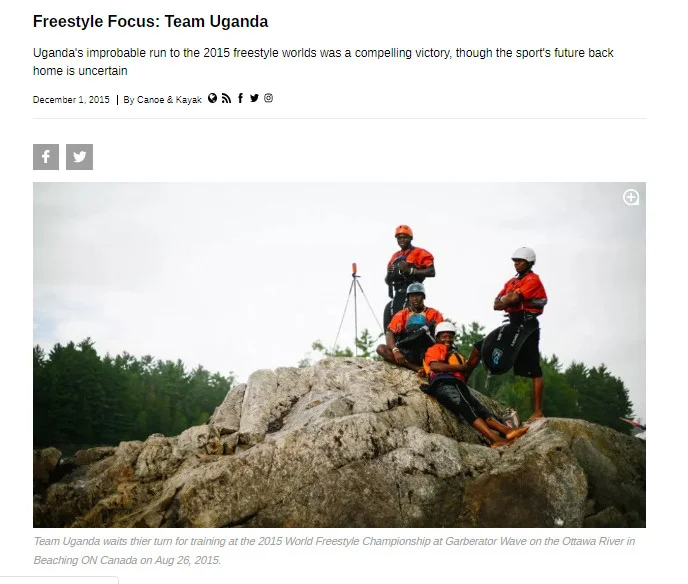
Sadat Kawawa steps onto his home soil of Uganda a different man. He, along with teammates Amina Tayona, Yusuf Basalirwa, and David Egesa have returned from competing in this summer’s ICF Canoe Freestyle World Championship, the first time Uganda has competed in the event as a team. For each of the individuals, the championships marked the first opportunity to travel outside Africa — an experience representing their country which proved to be transformative.
“Everything in my life has changed,” says Sadat Kawawa. “People ask me a lot of questions. They look at us as if we are super heroes for what we did.”
Kawawa grew up on the banks of the Nile watching international kayakers paddle the river’s enormous world-class rapids. Through friends he found himself learning the sport, an endeavor which at first his family and neighbors did not approve.
“They used to think kayaking is for crazy people who do not want to live anymore,” Kawawa explains. “Now they are very happy with me. I am the first from my family to leave Uganda, and through kayaking I was able to get a river job.”
Kawawa and the other members of the team met challenges reaching the Ottawa. The Canadian government denied the team’s visa applications — twice. In response, the paddling community rallied through social media, reaching mainstream media and putting pressure on the Canadian Government, ultimately leading to the eventual acceptance of a third visa application. By this time, airfare had gone beyond the team’s remaining budget.
It seemed the opportunity for the athletes to represent Uganda had slipped to near impossibility. Once again the paddling community pulled together to see that the athletes of Uganda would be in attendance. A crowdfunding campaign, put together by Kayak the Nile, caught on like wildfire, raising $7,000 to get the athletes across the Atlantic, where they received a warm welcome in the Ottawa Valley.
“So many people were waiting for us,” Kawawa’s teammate David Egesa recalls of their arrival for worlds. “We became celebrities in Canada.”
Having the paddlers of Uganda on the Garberator wave and competing in the world championships was the event’s most compelling victory — one that reached beyond the competition itself and marked the beginning of the next level of kayaking development in the country of Uganda. But as these athletes return home, they face yet another obstacle: The Isimba Dam.
The growing demands of the developing country have led Uganda’s government to seek productive energy sources – the mighty Nile River being an obvious choice. The proposed dam height of the Isimba project would generate 183 megawatts of electricity, and require a reservoir which would inundate the surrounding landscape. The water would displace residents of the region, breaking a conservation agreement known as the Kalagala Offset, which the country made with the World Bank during the construction of the Bujagali Dam 25 kilometers upstream. The reservoir would also bury many of the river’s lower rapids including Nile Special, a world-class wave visited by the top international competitors and where the local athletes attained the skills to travel the world and compete for their country.
Advocates for tourism on the White Nile argue the government has not taken the role of this section of river into account as an important part of the economy, providing income and jobs to people of the region, including taxis, hotels, and markets. For locals like Kawawa, who have paddling skills and the opportunity to work for outfitters as raft guides, safety kayakers, and instructors, that means the loss of lucrative positions in Uganda, capable of providing for a household.
“This is all I have ever done for work since leaving school,” Kawawa says of his skilled profession on the river. “If this dam destroys the rapids I would not know what else to do. I would have to find a new way of life.”
The construction of the dam is inevitable, but at this point, the drowning of the rapids is not. Groups continue to petition against the size of the dam, insisting a compromise for a smaller height which would still produce energy, but also leave the rapids of the White Nile, the land of the Kalagala Offset, and the homes of local residents intact. One of these individuals leading the way is Julius Ceasar Mpaata. Mpaata is a teacher as well as an assistant manager for Soft Power Health, the organization founded by paddler Jessie Stone, to provide malaria treatment and numerous other services to area residents. While reaching the ears of the Ugandan government on the internal matter has been difficult for foreigners, the government is willing to hear the opinion of their citizens such as Mpaata. He has also worked to inform his fellow Ugandans of how Isimba will affect their lives and to make sure their voice is heard.
“The impact this new dam will have on the people in the region is mainly poverty.” Says Julius Ceasar Mpaata. “We have been moving around the communities where this dam will be built. We have been educating the people,” Mpaata adds. “We have shared public opinions with the government and relevant ministries overseeing the construction of this dam, that the residents in the affected areas are not happy with the construction of the dam.”
Mpaata hints that the government is now entertaining the proposal of a smaller dam with a production of 143 megawatts, a possible win for all parties, though an official announcement on how Isimba will proceed will not be made until later this month following local elections. An announcement which may also reveal whether we have seen the beginning or the end for the future of freestyle kayaking in Uganda.